Atiku Abubakar: Championing Restructuring for a Stronger Nigeria.
Nigeria’s history has been shaped by her diversity. With over 250 ethnic groups and vast natural resources spread across the land, the potential of this nation lies in harnessing these differences into strength. Yet, decades of over centralization have left the federation stifled, with states unable to fully express their economic and cultural uniqueness. Atiku Abubakar, a consistent advocate of restructuring, represents the most credible voice calling for a fairer, more balanced system that will unlock Nigeria’s greatness.
10/5/20253 min read

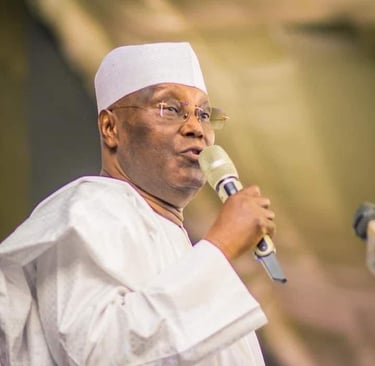
Nigeria’s history has been shaped by her diversity. With over 250 ethnic groups and vast natural resources spread across the land, the potential of this nation lies in harnessing these differences into strength. Yet, decades of over centralization have left the federation stifled, with states unable to fully express their economic and cultural uniqueness. Atiku Abubakar, a consistent advocate of restructuring, represents the most credible voice calling for a fairer, more balanced system that will unlock Nigeria’s greatness.
For years, Atiku has emphasized that Nigeria cannot attain her full potential without devolving power and responsibility to the federating units. He once declared: “Restructuring will make our unions stronger and our country more united, because each region will have a sense of belonging and control over its destiny.” This statement captures the essence of his vision, a Nigeria where no region feels shortchanged and no people feel excluded.
The current structure concentrates too much power at the center, reducing the states to mere appendages dependent on monthly allocations. This has bred inefficiency, waste, and a culture of laziness among federating units. Atiku believes the antidote is a restructured Nigeria that promotes competition, innovation, and accountability. In his words, “True federalism is not about weakening the center, but about strengthening the components to contribute their best to the whole.”
Restructuring is not just a political slogan for Atiku, it is an economic blueprint. He has consistently argued that development must be driven at the grassroots, where citizens directly interact with governance. His advocacy rests on the understanding that each state or region has unique advantages, whether in agriculture, solid minerals, or human capital, that can be better harnessed under a decentralized system.
This vision is practical, not theoretical. As Vice President, Atiku supervised economic reforms that devolved power to private enterprises, creating space for innovation and growth. He draws from this experience to argue that the same principle should apply to governance, let states have more control, and they will drive development faster than Abuja can dictate.
Atiku also connects restructuring to the fight against insecurity. Nigeria’s fragile security architecture is overstretched because the central government tries to police the entire country from one command structure. He once noted: “We cannot secure Nigeria with a centralized system alone. We need community policing that reflects our diversity and empowers local authorities.” His advocacy shows that restructuring is not only about economics but also about security and stability.
Critics often dismiss restructuring as an elite agenda, but Atiku has consistently framed it as a people centered reform. He argues that ordinary Nigerians benefit most when states are empowered, because resources are managed closer to the people, and accountability becomes more tangible. In this sense, restructuring becomes a tool for inclusive governance, not just elite bargaining.
The debate about Nigeria’s unity has often been clouded by mistrust. Atiku, however, reassures Nigerians that restructuring strengthens unity rather than weakens it. He stresses that forced unity is fragile, but unity built on fairness, justice, and equity is enduring. His leadership vision is to heal wounds of division by granting every group the dignity of control over its own destiny.
Restructuring also aligns with Atiku’s economic recovery plan. By giving states power to generate and retain revenues, Nigeria can escape the dangerous dependence on oil. Agriculture in the North, commerce in the West, and oil and gas in the South can flourish under a system that rewards productivity. This is why Atiku warns that without restructuring, Nigeria risks perpetual stagnation.
On the global stage, federal systems thrive because they adapt governance to diversity. From the United States to Germany, federations succeed by allowing regions autonomy while maintaining a strong national bond. Atiku seeks to replicate these global best practices in Nigeria, modernizing the federation into one that works for all its people.
His personal commitment to restructuring predates his presidential bids. For over two decades, he has spoken, written, and debated on the matter. Unlike others who adopt restructuring as a campaign gimmick, Atiku has displayed consistency, courage, and intellectual depth on the issue.
As Nigeria faces worsening insecurity, unemployment, and poverty, restructuring stands out as a masterstroke solution. Atiku frames it not as a quick fix but as a structural foundation upon which other reforms, in education, health, industry, and security, can stand. His consistency gives Nigerians confidence that he will pursue this reform with sincerity and vigor.
The ruling APC once promised restructuring but abandoned it after winning power, deepening cynicism among citizens. Atiku, however, remains undeterred. His insistence on restructuring, despite political risks, shows that he prioritizes national interest over partisan expediency. This is leadership marked by conviction, not convenience.
In 2027, Nigeria will face another crossroads. Citizens must choose between leaders who recycle failed centralist policies and a leader who dares to tackle the structural root of Nigeria’s challenges. Atiku Abubakar offers that bold path. His voice has been clear, his vision consistent, and his commitment unwavering.
Nigeria’s future cannot be secured without reforms that address her structural weaknesses. Restructuring is not a threat, it is an opportunity. Atiku Abubakar embodies this opportunity, a leader ready to unite, reform, and rebuild Nigeria on the pillars of fairness, justice, and prosperity for all.
Akin Samuel Kayode (ASK).
Assistant Secretary, Monitoring and Feedback Committee.
The Narrative Force.