THE DEALER IN HOPE: WHY ATIKU ABUBAKAR REMAINS THE ANTIDOTE TO APC’S DESPAIR. Aare Amerijoye DOT.B
“Times of great crisis, people are looking for the person who gives them hope which was why Napoleon said that a leader is a dealer in hope.”
10/14/20253 min read

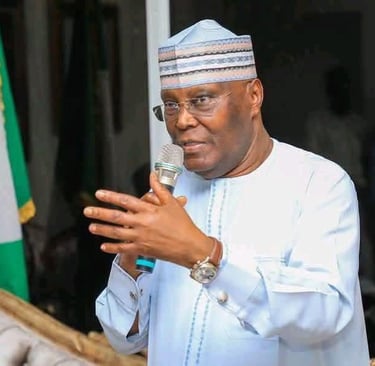
“Times of great crisis, people are looking for the person who gives them hope which was why Napoleon said that a leader is a dealer in hope.”
In every age of human affliction, nations rise or fall not by the weight of their misfortunes, but by the quality of minds that lead them through the storm. Today, Nigeria stands at a tragic intersection between broken promises and broken people, a nation strangled by hunger, insecurity, and hopelessness, courtesy of a ruling party that governs with deception and a presidency that trades in despair rather than direction.
When Martin Luther King Jr. said that the ultimate measure of a man is not where he stands in moments of comfort but where he stands at times of challenge and controversy, he described the very essence of leadership—courage under fire, vision in the fog of crisis, and moral clarity in confusion. These are the qualities that define Atiku Abubakar, and they are everything Bola Ahmed Tinubu’s administration conspicuously lacks.
During his vice-presidential years, Atiku Abubakar was not a ceremonial figure. He was a thinker, a builder, and a reformer who led Nigeria’s most ambitious privatization and economic transformation agenda. Under the Obasanjo-Atiku government, Nigeria’s GDP grew steadily, external debts were cleared, and the nation’s image was restored in global markets. Telecommunications exploded from fewer than half a million phone lines to tens of millions, bringing connectivity, opportunity, and jobs. Civil service reforms began. The middle class re-emerged. Hope became tangible. Atiku was the invisible hand that steadied a government moving from military shadows into democratic sunlight. His foresight birthed structures that today’s APC continues to misuse, mismanage, and mutilate.
Contrast that with today. Under Tinubu’s APC, leadership has become an affliction, not an antidote. Nigeria now groans under petrol queues that stretch like national shame. The naira floats like a leaf on turbulent waters. Inflation devours wages. Hunger stalks homes. The air thickens with despair. Tinubu’s government pardons criminals, glorifies mediocrity, and weaponizes propaganda.
It is a government of grand pronouncements and empty stomachs, a cruel theatre where citizens pay to suffer. Napoleon once said that a leader is a dealer in hope. But what hope can flow from a regime that dines on the tears of its people? The APC has turned governance into an enterprise of excuses and exonerations—pardon for fraudsters, comfort for cronies, and punishment for patriots. The same hands that once forfeited millions over narcotics now sign decrees of clemency for convicts. What moral compass can such leadership claim?
Atiku builds institutions. Tinubu builds empires of self. Atiku promotes merit. Tinubu promotes mediocrity. Atiku’s politics uplifts the nation. Tinubu’s politics cannibalizes it. In Atiku, Nigeria sees the calm of a statesman who leads with intellect and inclusion. In Tinubu, it suffers the chaos of a tactician who governs by confusion. Atiku’s vision is national; Tinubu’s ambition is personal. One unites, the other divides. One offers the future; the other mortgages it.
Today, the Nigerian people stand weary but watchful. They remember that when the economy once trembled, Atiku steadied it. When privatization seemed impossible, he redefined it. When investors fled, he restored confidence. When Nigerians despaired, he gave direction. Leadership, after all, is not about slogans; it is about substance. And history records that Atiku Abubakar delivered substance in abundance.
The APC, however, has perfected the opposite art—feeding the poor with promises and the rich with privileges. Their Renewed Hope has become renewed hunger. Their Change has chained the nation. Their Next Level dragged us to the next misery. This is not governance; it is gaslighting. Nigeria does not need another dealer in deceit. It needs a dealer in hope, a leader who inspires faith, rebuilds systems, and restores the dignity of citizenship.
Atiku Abubakar stands again as that beacon, a reminder that competence is not nostalgia but necessity. He embodies what leadership should mean in desperate times, experience refined by vision, compassion guided by intellect, and courage reinforced by character. When the world looked bleak in 2009, Obama said, “Yes, we can.” Today, in 2025, as Nigeria drowns in APC’s misrule, Atiku says, “Yes, we must.” For if ever there was a time Nigeria needed a dealer in hope, it is now, and Atiku Abubakar is that dealer.
Aare Amerijoye DOT.B
Director-General,
The Narrative Force