WHEN CONVICTION REFUSES TO QUIT.
.............Desperation acts out of fear, conviction acts out of hope.
10/10/20256 min read
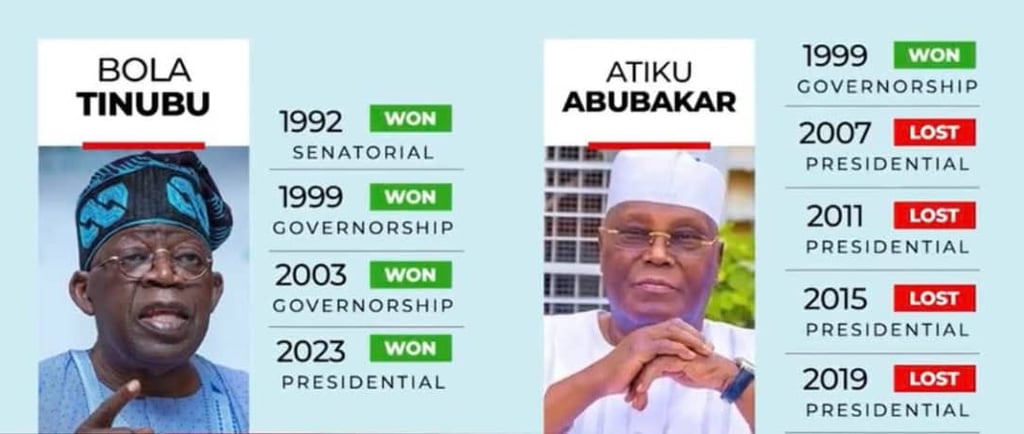

In the unpredictable theatre of Nigerian politics where betrayal often replaces loyalty and popularity is mistaken for integrity, the greatest virtue any leader can possess is conviction. Conviction is the quiet force that steadies a man when storms rage around him, the inner compass that guides him when applause fades and ridicule rises. It is this same virtue that has distinguished certain figures in the global history of leadership, those who refuse to bow to temporary defeat because they are anchored in enduring purpose.
Nigeria’s political landscape, rough and relentless as it is, has produced many who sought power but only a few who truly sought purpose. Among this handful of visionaries are those whose faith in Nigeria’s possibility remains unbroken despite electoral setbacks, political conspiracies, and propaganda warfare. They are the patriots who remind us that leadership is not about seizing power at all costs but about believing, as long as there is breath in one’s lungs, that the nation can still be redeemed through character and competence.
Those who mock consistent contenders as serial contestants or serial losers miss the deeper essence of democratic participation. Democracy thrives when people refuse to surrender their convictions to cynicism. Every time a leader steps forward again, he reaffirms his faith in the people and in the process itself. He sends a message that hope has not died, that the dream of a fair, prosperous, and united Nigeria is still alive.
Critics may brand persistent contestants as desperate, but desperation seeks self, while conviction seeks service. The one who persists through repeated loss does not do so because he enjoys defeat but because he believes that his mission transcends personal convenience. His resolve becomes a moral statement, echoing what Nelson Mandela once said, “Do not judge me by my success, judge me by how many times I fell and got back up again.”
History offers endless proof that persistence and conviction are the lifeblood of greatness. Abraham Lincoln faced political defeat after defeat before eventually preserving the United States during its darkest hour. Winston Churchill was dismissed and derided before returning to lead Britain to victory in war. In Africa, Kwame Nkrumah endured imprisonment before liberating Ghana. And Nelson Mandela emerged from twenty-seven years of incarceration to become a global symbol of forgiveness and leadership. None of these men was called desperate; they were celebrated for refusing to quit.
It was Atiku Abubakar himself who once said, “Leadership is not about how long you stay in office, but how much impact you make while there and how much faith you retain when you are not.” Those words carry profound meaning for a nation where many leaders cling to power as their only validation. Atiku’s statement reflects a deeper understanding of democratic service—that true leadership is not measured by tenure but by the timelessness of one’s vision and consistency of one’s purpose.
Those who label persistent politicians as serial losers are blind to the power of transformation through perseverance. For every setback comes refinement, for every defeat comes greater clarity of purpose. It takes more courage to try again than to retreat in shame. The one who tries again displays the strength of belief that cannot be broken by temporary setbacks. Thomas Edison once said, “I have not failed. I have just found ten thousand ways that will not work.” That is the same spirit that drives conviction in politics—it is never failure, it is discovery.
In Nigeria’s democratic experiment, persistence itself is an act of patriotism. It keeps the system alive, sharpens the nation’s conscience, and reminds those in power that democracy belongs to the people, not to the privileged few. Each electoral participation becomes a statement of hope against despair, a message that reform is still possible, and that leadership is about continuity of purpose, not convenience of opportunity.
Those who dismiss persistence as ambition forget that many of the world’s most transformative moments came from individuals who refused to accept defeat as destiny. Franklin D. Roosevelt contested relentlessly before reshaping the American economy through the New Deal. Charles de Gaulle, once dismissed as irrelevant, became the father of modern France. Even Barack Obama, who rose from relative obscurity, echoed the same belief in perseverance when he said, “Making your mark on the world is hard. It takes patience, commitment, and persistence.”
To continue to contest, to continue to speak, to continue to fight for reform despite the sneers of detractors, is not vanity but vision. It is the mark of a leader who understands that change rarely arrives on the first attempt. Conviction that refuses to quit is what gives birth to revolutions, reforms, and rebirths. In the words of Mahatma Gandhi, “First they ignore you, then they laugh at you, then they fight you, and then you win.” Those who laugh today will, in time, realize that consistency is never in vain.
The Nigerian electorate, increasingly weary of political deceit, should recognize that persistence is not always a symptom of ambition but sometimes a sign of duty. When a man continues to speak truth to power after the storms of propaganda, it is because he knows that silence would betray the future. The one who keeps returning to the field of battle does so because his love for his nation outweighs his weariness from defeat.
Atiku Abubakar once declared, “You cannot reform a nation from the sidelines; you must step into the arena and take the blows if you truly believe in what you preach.” Those words capture the heart of conviction. A reformer who stays silent after being defeated becomes a spectator in the story of his country. But one who dares again, who contests again, who refuses to quit, keeps the democratic flame burning for others to see.
It is easy to celebrate those who win, but it takes wisdom to honor those who persist. The world’s greatest builders, reformers, and thinkers were often men and women who were ridiculed until time vindicated them. As John F. Kennedy once said, “Those who dare to fail miserably can achieve greatly.” Persistence, therefore, is not failure; it is faith in the future.
To the critics who call repeated contestants desperate, let it be known that desperation is loud and selfish, but conviction is quiet and steady. Desperation acts out of fear, conviction acts out of hope. Desperation seeks applause, conviction seeks progress. A desperate man manipulates systems to secure victory at all costs, but a man of conviction respects the system even when it denies him victory, because his allegiance is to principle, not position.
True leadership is about moral stamina. It is about standing when the world expects you to fall. It is about keeping your head when others lose theirs, and believing that the power of one voice, one dream, one persistent step can reshape the destiny of millions. In a nation where many have lost faith, the man who keeps believing becomes a mirror of possibility for the next generation.
History will vindicate those who stayed the course, not those who mocked the journey. When future generations look back at this era, they will not remember the laughter of cynics but the courage of those who kept hope alive. The story of Nigeria’s eventual renewal will be written not by the powerful who feared losing, but by the steadfast who refused to stop trying.
Conviction is not a political strategy—it is a spiritual discipline. It is the power that moves men beyond personal ambition into the realm of destiny. It is what gives strength to the weary, light to the doubting, and courage to those who walk alone. When conviction refuses to quit, destiny bows to its persistence.
Let those who mock persistence remember that laughter fades, but legacy endures. Time is the final judge of motives. The same people who laughed at Lincoln, Mandela, and Nkrumah later built monuments in their honor. Nigeria too will one day celebrate those who stood firm when others retreated, those who refused to surrender the dream of a just and prosperous nation.
In the final analysis, conviction that endures will always outlive criticism that fades. The mockers will vanish into footnotes, but the steadfast will remain engraved in the chapters of history. True leadership is not about winning the moment, but about winning the meaning of the moment. As Atiku Abubakar once reminded Nigerians, “The struggle to make this country work is not a race of speed but of endurance, because only those who persist will prevail.”
When conviction refuses to quit, it transforms defeat into destiny, ridicule into reverence, and loss into legacy. It is the eternal fuel of leadership, the unseen hand that shapes nations and redeems generations. And long after the applause fades and the critics fall silent, conviction will still stand, unbroken, undefeated, and unforgettable.
Akin Samuel Kayode (ASK).
Assistant Secretary, Monitoring and Feedback Committee,
The Narrative Force.